ZTE Communications ›› 2025, Vol. 23 ›› Issue (4): 16-26.DOI: 10.12142/ZTECOM.202504004
• Special Topic • Previous Articles Next Articles
CHEN Zhe1( ), ZHOU Peigen1, WANG Long2, HOU Debin2, HU Yun3, CHEN Jixin1, HONG Wei1
Received:2025-09-15
Online:2025-12-22
Published:2025-12-22
About author:CHEN Zhe (zhechen@seu.edu.cn) received his BS degree in microwave engineering from University of Electronic Science and Technology of China in 2006, and his PhD degree in electronic engineering from Southeast University, China in 2014. From 2016 to 2018, he was with The University of Texas, USA. He is currently an associate professor with the State Key Laboratory of Millimeter Waves, School of Information Science and Technology, Southeast University. His research interests include terahertz signal sources and high-speed communications and millimeter wave integrated circuits in nanometer silicon-based technology. He served as the Session Chair for the IEEE International Symposium on Radio-Frequency Integration Technology (RFIT), the IEEE International Wireless Symposium (IWS), and the IEEE International Conference on Microwave and Millimeter Wave Technology (ICMMT).CHEN Zhe, ZHOU Peigen, WANG Long, HOU Debin, HU Yun, CHEN Jixin, HONG Wei. FTTR-MmWave Architecture for Next-Generation Indoor High-Speed Communications[J]. ZTE Communications, 2025, 23(4): 16-26.
Add to citation manager EndNote|Ris|BibTeX
URL: https://zte.magtechjournal.com/EN/10.12142/ZTECOM.202504004

Figure 1 Schematic diagram of FTTR-mmWave cascading in the U-CAN architecture: (a) overall U-CAN architecture and (b) FTTR-mmWave system

Figure 2 Block diagram of the 24–29.5 GHz chipset: (a) Tx chip and (b) Rx chip

Figure 3 Chip micrograms and measurement results: (a) micrograph of the 24–29.5 GHz Rx chip; (b) micrograph of the 24–29.5 GHz Tx chip; (c) over-the-air (OTA) measurement setup; (d) measured EVM with single carrier modulation signal
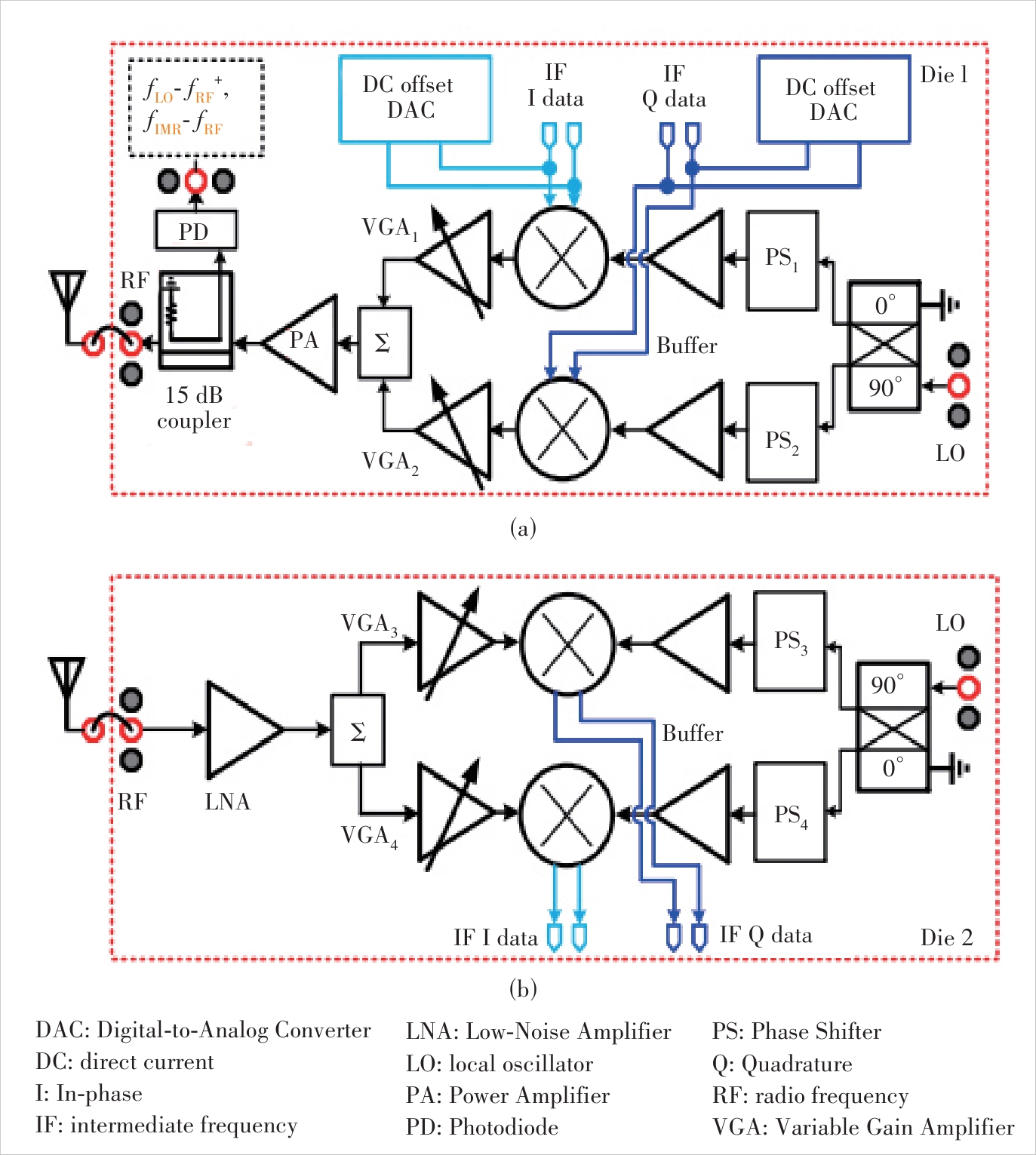
Figure 4 Block diagram of the 45-GHz direct-conversion chipset: (a) Tx chip and (b) Rx chip

Figure 5 Chip micrographs and measurement results for the 45 GHz transceiver: (a) Tx chip; (b) Rx chip; (c) OTA measurement setup; (d) measured 64-QAM constellation
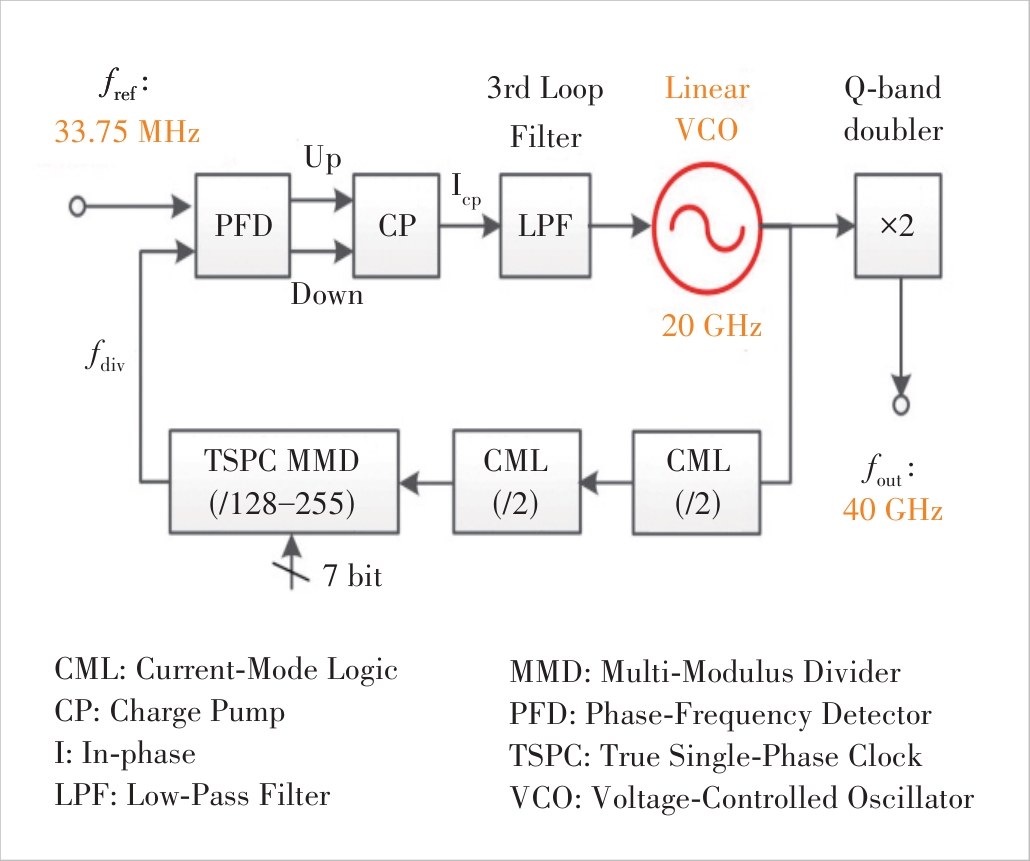
Figure 6 Block diagram of the 40 GHz Integer-N PLL

Figure 7 Micrograph of the 40 GHz Integer-N PLL

Figure 8 The 26/28-GHz 8-channel TR and Up/Down-conversion chipsets (Image courtesy of MiSic Microelectronics Co., Ltd.)

Figure 9 45-GHz 2-channel transceiver chip for mmWave Wi-Fi (IEEE802.11aj) applications(Image courtesy of MiSic Microelectronics Co., Ltd.)
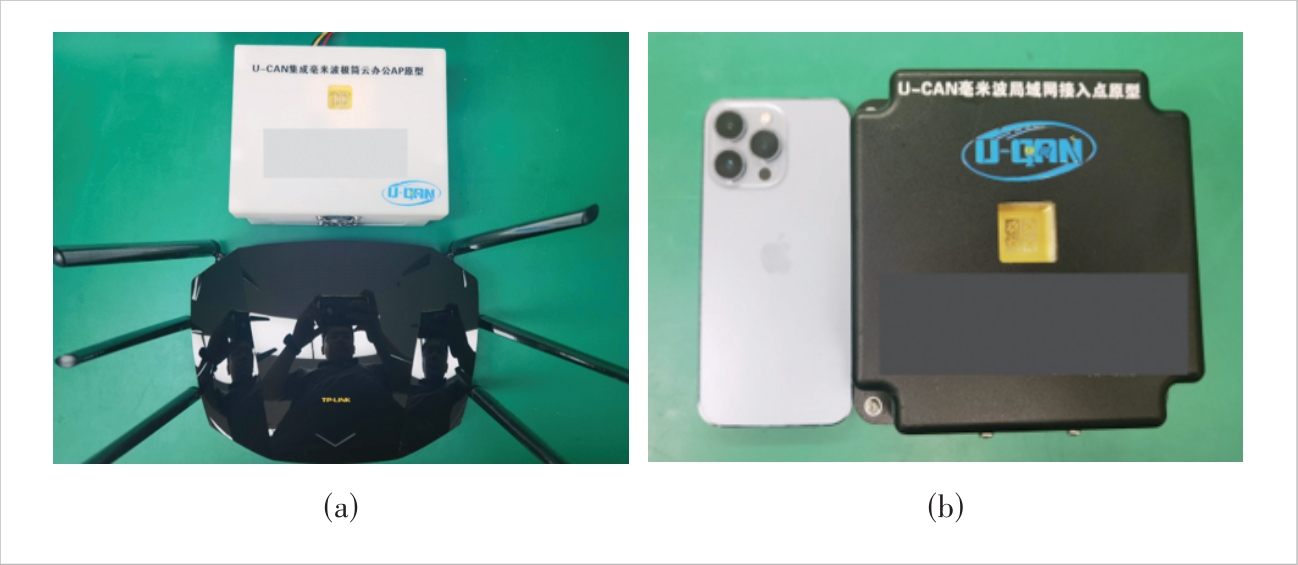
Figure 10 MmWave Wi-Fi modules for: (a) access point and (b) user terminal (Image courtesy of MiSic and Ziwei Tech., etc.)
| [1] | SCHNEIDER T, WIATREK A, PREUßLER S, et al. Maximum transmittable data rates for millimeter-wave fixed wireless links [C]//Proc. 2012 ELEKTRO. IEEE, 2012: 94–98. DOI: 10.1109/ELEKTRO.2012.6225579 |
| [2] | GHASEMPOUR Y, SILVA C R C M DA, CORDEIRO C, et al. IEEE 802.11ay: next-generation 60 GHz communication for 100 Gb/s Wi-Fi [J]. IEEE communications magazine, 2017, 55(12): 186–192. DOI: 10.1109/MCOM.2017.1700393 |
| [3] | KIM M, ROPITAULT T, LEE S, et al. Efficient MU-MIMO beamforming protocol for IEEE 802.11ay WLANs [J]. IEEE communications letters, 2019, 23(1): 144–147. DOI: 10.1109/LCOMM.2018.2879476 |
| [4] | KIM M S. Deep learning based multiple-beam transmission for IEEE 802.11ay beamforming training [C]//Proc. 27th Asia Pacific Conference on Communications (APCC). IEEE, 2022: 494–495. DOI: 10.1109/APCC55198.2022.9943719 |
| [5] | ALDUBAIKHY K, WU W, ZHANG N, et al. MmWave IEEE 802.11ay for 5G fixed wireless access [J]. IEEE wireless communications, 2020, 27(2): 88–95. DOI: 10.1109/MWC.001.1900174 |
| [6] | HE C, REN Z X, WANG X, et al. Millimeter-wave wireless communications for home network in fiber-to-the-room scenario [J]. Frontiers of information technology & electronic engineering, 2021, 22(4): 441–456. DOI: 10.1631/FITEE.2000440 |
| [7] | IEEE. IEEE standard for information technology—local and metropolitan area networks—specific requirements part 15.3: amendment 2: millimeter-wave-based alternative physical layer extension: IEEE Std 802.15.3c-2009 [S]. 2009 |
| [8] | SEYEDI A. On the physical layer performance of ecma-387: a standard for 60GHz WPANs [C]//Proc. IEEE International Conference on Ultra-Wideband. IEEE, 2009: 28–32. DOI: 10.1109/ICUWB.2009.5288820 |
| [9] | IEEE. IEEE standard for information technology—telecommunications and information exchange between systems—local and metropolitan area networks—specific requirements part 11: wireless LAN medium access control (MAC) and physical layer (PHY) specifications amendment 3: enhancements for very high throughput in the 60 GHz band: IEEE Std 802.11ad-2012 [S]. 2012 |
| [10] | IEEE. IEEE standard for information technology—telecommunications and information exchange between systems local and metropolitan area networks—specific requirements part 11: wireless LAN medium access control (MAC) and physical layer (PHY) specifications amendment 3: enhancements for very high throughput to support chinese millimeter wave frequency bands (60 GHz and 45 GHz): IEEE Std 802.11aj-2018 [S]. 2018 |
| [11] | IEEE. IEEE standard for information technology—telecommunications and information exchange between systems local and metropolitan area networks—specific requirements part 11: wireless lan medium access control (MAC) and physical layer (PHY) specifications amendment 2: enhanced throughput for operation in license-exempt bands above 45 GHz: IEEE Std 802.11ay-2021 [S]. 2021 |
| [12] | AI B, GUAN K, HE R S, et al. On indoor millimeter wave massive MIMO channels: measurement and simulation [J]. IEEE journal on selected areas in communications, 2017, 35(7): 1678–1690. DOI: 10.1109/JSAC.2017.2698780 |
| [13] | AKDENIZ M R, LIU Y P, SAMIMI M K, et al. Millimeter wave channel modeling and cellular capacity evaluation [J]. IEEE journal on selected areas in communications, 2014, 32(6):1164–1179. DOI: 10.1109/JSAC.2014.2328154 |
| [14] | ALKHATEEB A, AYACH O EL, LEUS G, et al. Channel estimation and hybrid precoding for millimeter wave cellular systems [J]. IEEE journal of selected topics in signal processing, 2014, 8(5): 831–846. DOI: 10.1109/JSTSP.2014.2334278 |
| [15] | CHEN J N, LI S, TAO J Y, et al. Wireless beam modulation: an energy- and spectrum-efficient communication technology for future massive IoT systems [J]. IEEE wireless communications, 2020, 27(5): 60–66. DOI: 10.1109/MWC.001.2000021 |
| [16] | CUI P F, ZHANG J A, LU W J, et al. Statistical sparse channel modeling for measured and simulated wireless temporal channels [J]. IEEE transactions on wireless communications, 2019, 18(12): 5868–5881. DOI: 10.1109/TWC.2019.2940017 |
| [17] | GENC Z, DANG B L, WANG J, et al. Home networking at 60 GHz: challenges and research issues [C]//The International Federation for Information Processing (IFIP). Springer, 2008. DOI: 10.1007/978-0-387-77216-5_5 |
| [18] | HUR S, KIM T, LOVE D J, et al. Millimeter wave beamforming for wireless backhaul and access in small cell networks [J]. IEEE transactions on communications, 2013, 61(10): 4391–4403. DOI: 10.1109/TCOMM.2013.090513.120848 |
| [19] | MORAITIS N, CONSTANTINOU P. Indoor channel measurements and characterization at 60 GHz for wireless local area network applications [J]. IEEE transactions on antennas and propagation, 2004, 52(12): 3180–3189. DOI: 10.1109/TAP.2004.836422 |
| [20] | RANGAN S, RAPPAPORT T S, ERKIP E. Millimeter-wave cellular wireless networks: potentials and challenges [J]. Proceedings of the IEEE, 2014, 102(3):366-385. DOI: 10.1109/JPROC.2014.2299397 |
| [21] | SATO K, MANABE T, IHARA T, et al. Measurements of reflection and transmission characteristics of interior structures of office building in the 60-GHz band [J]. IEEE transactions on antennas and propagation, 1997, 45(12): 1783–1792. DOI: 10.1109/8.650196 |
| [22] | WU X Y, WANG C X, SUN J, et al. 60-GHz millimeter-wave channel measurements and modeling for indoor office environments [J]. IEEE transactions on antennas and propagation, 2017, 65(4): 1912–1924. DOI: 10.1109/TAP.2017.2669721 |
| [23] | LIU X, LI J W, WU X M, et al. Fiber-to- the-room (FTTR) technologies for the 5th generation fixed network (F5G) and beyond [C]//Proc. IEEE Future Networks World Forum (FNWF). IEEE, 2022: 351–354. DOI: 10.1109/FNWF55208.2022.00068 |
| [24] | CAI Y. Discussion on the construction of FTTR gigabit full optical network for smart home [J]. Telecom power technologies, 2022, 39(2): 92–94. DOI:10.19399/j.cnki.tpt.2022.02.029 |
| [25] | CHEN P N, ZHAO Z J, WANG X X. Research on the development and application of FTTR technology in the context of gigabit network development [J]. Telecom power technologies, 2021, 38(17): 85–87. DOI: 10.19399/j.cnki.tpt.2021.17.024 |
| [26] | SUN L. U-CAN ultra-converged access network architecture and key technologies [C]//2024 National Conference on Microwave and Millimeter Wave. CIE, 2024. DOI: 10.26914/c.cnkihy.2024.019769 |
| [27] | NOR A M. Access point selection in beyond 5G hybrid MmWave/Wi-Fi/Li-Fi network [J]. Physical communication, 2021, 46(6): 1–11, DOI: 10.1016/j.phycom.2021.101299 |
| [28] | SUN X, YAO W B, MAO J H, et al. Research on 5G multi frequency coordination technology [J]. Telecom engineering technics and standardization, 2021, 34(3): 75–81. DOI: 10.13992/j.cnki.tetas.2021.03.017 |
| [29] | HU T Y, LI L X, CHEN Z. New opportunities for multi-band collaborative communication: Integrated communications and sensing at terahertz band [J]. ZTE technology journal, 2022, 28(4): 14–18. DOI:10.12142/ZTETJ.202204004 |
| [30] | IEEE. IEEE Standard for Wireless LAN Medium Access Control (MAC) and Physical Layer (PHY) specifications: IEEE Std 802.11-1997 [S]. 1997 |
| [31] | WANG L, CHEN J X, CHEN Z, et al. A 24–29.5-GHz scalable 2 × 2 I-Q TX/RX chipset with streamlined IF interfaces for DBF systems [J]. IEEE transactions on circuits and systems I: regular papers, 2025, 72(1): 155–168. DOI: 10.1109/TCSI.2024.3438555 |
| [32] | ZHOU P G, CHEN J X, YAN P P, et al. A -28.5-dB EVM 64-QAM 45-GHz transceiver for IEEE 802.11aj [J]. IEEE journal of solid-state circuits, 2021, 56(10): 3077–3093. DOI: 10.1109/JSSC.2021.3057077 |
| [33] | CHEN Z, WANG M, CHEN J X, et al. Linear CMOS LC-VCO based on triple-coupled inductors and its application to 40-GHz phase-locked loop [J]. IEEE transactions on microwave theory and techniques, 2017, 65(8): 2977–2989. DOI: 10.1109/TMTT.2017.2663401 |
| [34] | MiSic Microelectronics Co., Ltd. Product center [DB/OL]. [2025-08-10]. |
| [1] | YANG Mao, LI Bo, YAN Zhongjiang. Insights on Next Generation WLAN: High Experiences (HEX) [J]. ZTE Communications, 2025, 23(4): 10-15. |
| [2] | LIU Yichen, GAO Ruixin, ZENG Chen, LIU Yingzhuang. A Transformer-Based End-to-End Receiver Design for Wi-Fi 7 Physical Layer [J]. ZTE Communications, 2025, 23(4): 27-36. |
| [3] | YU Weichao, LIU Yang, ZHANG Junxiong, YE Junliang, GE Xiaohu. Root Cause Analysis of Poor FTTR Quality Based on Transformer Mechanisms [J]. ZTE Communications, 2025, 23(4): 37-47. |
| [4] | CAI Jinhan, ZAN Mingyuan, SHEN Gangxiang. QoS-Aware Energy Saving Based on Multi-Threshold Dynamic Buffer for FTTR Networks [J]. ZTE Communications, 2025, 23(4): 48-64. |
| [5] | ZHANG Yang, CEN Zihan, ZHAN Wen, CHEN Xiang. C-WAN for FTTR: Enabling Low-Overhead Joint Transmission with Deep Learning [J]. ZTE Communications, 2025, 23(4): 65-76. |
| [6] | ZHANG Boyu, ZHANG Ling, LI Zijing, SHEN Ying. Full-Duplex Massive MIMO Self-Interference Suppression Based on Beamforming [J]. ZTE Communications, 2025, 23(4): 97-109. |
| [7] | SHAN Yaru, WANG Fanggang, HAO Yaxing, HUA Jian, XIN Yu. Doppler Rate Estimation for OTFS via Large-Scale Antenna Array [J]. ZTE Communications, 2025, 23(1): 115-122. |
| [8] | CHEN Guangyi, ZHANG Ruoyu, REN Hong, LIN Xu, WU Wen. Joint Beamforming Design for Dual-Functional Radar-Communication Systems Under Beampattern Gain Constraints [J]. ZTE Communications, 2024, 22(3): 13-20. |
| [9] | ZHU Yuting, XU Zhiyu, ZHANG Hongtao. Cooperative Distributed Beamforming Design for Multi-RIS Aided Cell-Free Systems [J]. ZTE Communications, 2024, 22(2): 99-106. |
| [10] | GONG Panyin, ZHANG Guidong, ZHANG Zhigang, CHEN Xiao, DING Xuan. Research on Fall Detection System Based on Commercial Wi-Fi Devices [J]. ZTE Communications, 2023, 21(4): 60-68. |
| [11] | JI Yuhe, HAN Jing, ZHAO Yongxin, ZHANG Shenglin, GONG Zican. Log Anomaly Detection Through GPT-2 for Large Scale Systems [J]. ZTE Communications, 2023, 21(3): 70-76. |
| [12] | ZHU Yuting, LI Zeng, ZHANG Hongtao. Robust Beamforming Under Channel Prediction Errors for Time-Varying MIMO System [J]. ZTE Communications, 2023, 21(3): 77-85. |
| [13] | TANG Yuanqi, ZHANG Huimin, ZHENG Zheng, LI Ping, ZHU Yu. Hybrid Architecture and Beamforming Optimization for Millimeter Wave Systems [J]. ZTE Communications, 2023, 21(3): 93-104. |
| [14] | JIA Haonan, HE Zhenqing, TAN Wanlong, RUI Hua, LIN Wei. Distributed Multi-Cell Multi-User MISO Downlink Beamforming via Deep Reinforcement Learning [J]. ZTE Communications, 2022, 20(4): 69-77. |
| [15] | HOU Xiaolin, LI Xiang, WANG Xin, CHEN Lan, SUYAMA Satoshi. Some Observations and Thoughts about Reconfigurable Intelligent Surface Application for 5G Evolution and 6G [J]. ZTE Communications, 2022, 20(1): 14-20. |
| Viewed | ||||||
|
Full text |
|
|||||
|
Abstract |
|
|||||