ZTE Communications ›› 2025, Vol. 23 ›› Issue (4): 10-15.DOI: 10.12142/ZTECOM.202504003
• Special Topic • Previous Articles Next Articles
YANG Mao( ), LI Bo, YAN Zhongjiang
Received:2025-09-11
Online:2025-12-25
Published:2025-12-22
About author:YANG Mao (yangmao@nwpu.edu.cn) received his BE and MS degrees in information and telecommunication engineering from Xidian University, China in 2006 and 2009, respectively, and his PhD degree in electronic engineering from Tsinghua University, China in 2014. He is currently an associate professor in the School of Electronics and Information, Northwestern Polytechnical University, China. His research interests focus on wireless networking and communications, including next-generation cellular networks (6G) and WLAN (e.g. IEEE 802.11bn), the MAC and higher-layer technologies, non-orthogonal multiple access for 6G, software-defined wireless networking, and wireless network virtualization. His research projects are funded by the National Natural Science Foundation of China. He has published over 100 research papers and has over 100 granted and pending international and Chinese patents. He is a member of the IEEE and a voting member of IEEE 802.11Working Group.YANG Mao, LI Bo, YAN Zhongjiang. Insights on Next Generation WLAN: High Experiences (HEX)[J]. ZTE Communications, 2025, 23(4): 10-15.
Add to citation manager EndNote|Ris|BibTeX
URL: https://zte.magtechjournal.com/EN/10.12142/ZTECOM.202504003
| Feature | WLAN | Cellular Network |
|---|---|---|
| Network deployment | Advantages: easy, open, and flexible to deploy Disadvantages: interference is difficult to control | Advantages: interference is controllable Disadvantages: in need of careful design and test; inflexible that only allows the mobile operators to deploy |
| Channel access and transmission | Advantages: easy to access the channel for each device with less control and management signaling Disadvantages: strong interference and collisions and low resource utilization ratio | Advantages: collision-free; little interference and high resource utilization ratio Disadvantages: all uplink and downlink channel access and transmission need to be scheduled by the base station with heavy control and management signaling |
| QoS and QoE | Advantages: in light traffic load scenarios, the access latency is low because of random access strategy Disadvantages: in medium or heavy traffic load scenarios, the QoS and QoE are quite poor and uncertain | Advantages: high certainty Disadvantages: high access latency because of heavy signaling in light traffic load scenario |
Table 1 Comparisons between WLANs and cellular networks
| Feature | WLAN | Cellular Network |
|---|---|---|
| Network deployment | Advantages: easy, open, and flexible to deploy Disadvantages: interference is difficult to control | Advantages: interference is controllable Disadvantages: in need of careful design and test; inflexible that only allows the mobile operators to deploy |
| Channel access and transmission | Advantages: easy to access the channel for each device with less control and management signaling Disadvantages: strong interference and collisions and low resource utilization ratio | Advantages: collision-free; little interference and high resource utilization ratio Disadvantages: all uplink and downlink channel access and transmission need to be scheduled by the base station with heavy control and management signaling |
| QoS and QoE | Advantages: in light traffic load scenarios, the access latency is low because of random access strategy Disadvantages: in medium or heavy traffic load scenarios, the QoS and QoE are quite poor and uncertain | Advantages: high certainty Disadvantages: high access latency because of heavy signaling in light traffic load scenario |
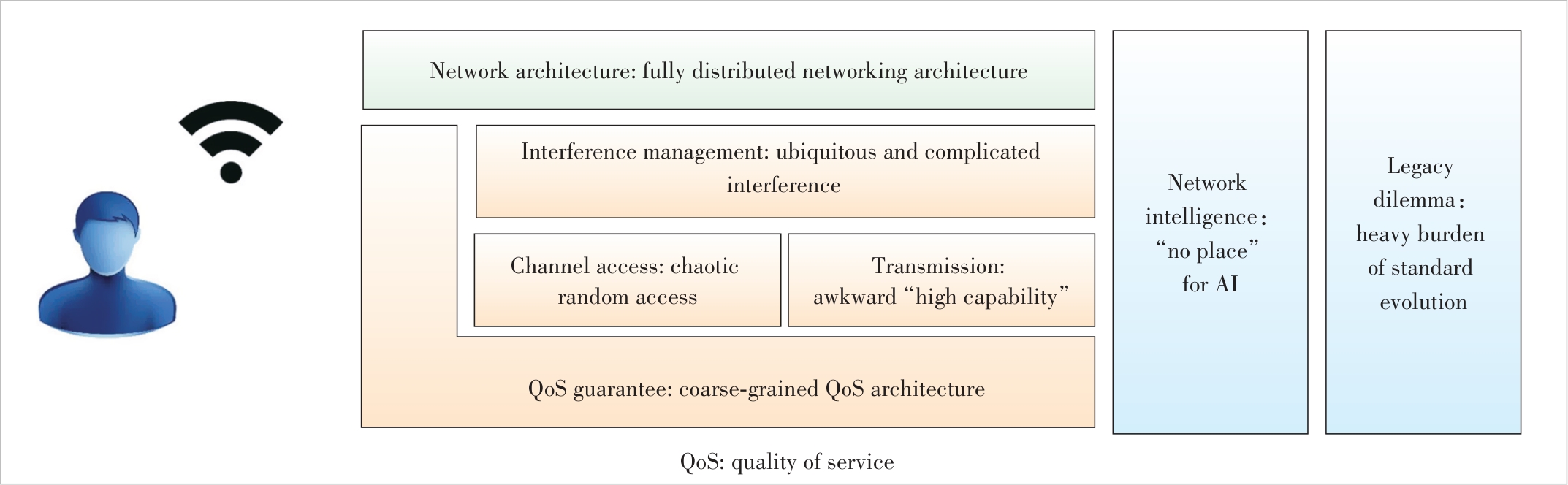
Figure 1 Architecture of the key technical problems that cause poor QoE of WLANs
| Feature | Problem | Threat | Importance |
|---|---|---|---|
| Network architecture | Fully-distributed networking architecture | Disorder | ★★★★★ |
| Channel access | Chaotic random access | Disorder | ★★★★★ |
| Transmission | Awkward “high capability” | Low efficiency | ★★★★ |
| QoS guarantee | Coarse-grained QoS architecture | Weak adaptability | ★★★★ |
| Interference management | Ubiquitous and complicated interference | Disorder | ★★★★ |
| Network intelligence | “No place” for AI | Weak adaptability | ★★★ |
| Legacy dilemma | Heavy burden of standard evolution | Hindering evolution | ★★★ |
Table 2 Summary of the key technical problems that lead to poor quality of experience of WLANs
| Feature | Problem | Threat | Importance |
|---|---|---|---|
| Network architecture | Fully-distributed networking architecture | Disorder | ★★★★★ |
| Channel access | Chaotic random access | Disorder | ★★★★★ |
| Transmission | Awkward “high capability” | Low efficiency | ★★★★ |
| QoS guarantee | Coarse-grained QoS architecture | Weak adaptability | ★★★★ |
| Interference management | Ubiquitous and complicated interference | Disorder | ★★★★ |
| Network intelligence | “No place” for AI | Weak adaptability | ★★★ |
| Legacy dilemma | Heavy burden of standard evolution | Hindering evolution | ★★★ |
| [1] | YANG M, LI B. Survey and perspective on extremely high throughput (EHT) WLAN: IEEE 802.11be [J]. Mobile networks and applications, 2020, 25(5): 1765–1780. DOI: 10.1007/s11036-020-01567-7 |
| [2] | Cisco. Visual networking index: white paper [R]. San Jose, USA: Cisco, 2020 |
| [3] | DENG C L, FANG X M, HAN X, et al. IEEE 802.11be Wi-Fi 7: new challenges and opportunities [J]. IEEE communications surveys & tutorials, 2020, 22(4): 2136–2166. DOI: 10.1109/COMST.2020.3012715 |
| [4] | LAN/MAN Standards Committee of IEEE Computer Society. IEEE standard for information technology-telecommunications and information exchange between systems local and metropolitan area networks specific requirements. Part 11: wireless LAN medium access control (MAC) and physical layer (PHY) specifications. Amendment 2: enhancements for extremely high throughput (EHT): IEEE Std 802.11be-2024 [S]. 2025 |
| [5] | GALATI-GIORDANO L, GERACI G, CARRASCOSA M, et al. What will Wi-Fi 8 be? A primer on IEEE 802.11bn ultra high reliability [J]. IEEE communications magazine, 2024, 62(8): 126–132. DOI: 10.1109/MCOM.001.2300728 |
| [6] | WEI D Y, CAO L, ZHANG L, et al. Optimized non-primary channel access design in IEEE 802.11bn [C]//IEEE Global Communications Conference. IEEE, 2024: 4588–4593. DOI: 10.1109/GLOBECOM52923.2024.10901367 |
| [7] | WILHELMI F, GALATI-GIORDANO L, GERACI G, et al. Throughput analysis of IEEE 802.11bn coordinated spatial reuse [C]//IEEE Conference on Standards for Communications and Networking (CSCN). IEEE, 2023: 401–407. DOI: 10.1109/CSCN60443.2023.10453190 |
| [8] | MECKLENBURG B, ANSARI A H, RICHERZHAGEN B, et al. Seamless roaming based on distributed multi-link operation over IEEE 802.11bn [C]//International Conference on Factory Communication Systems (WFCS). IEEE, 2025: 1–8. DOI: 10.1109/WFCS63373.2025.11077616 |
| [9] | NUNEZ D, WILHELMI F, GALATI-GIORDANO L, et al. Spatial reuse in IEEE 802.11bn coordinated multi-AP WLANs: a throughput analysis [C]//IEEE Conference on Standards for Communications and Networking (CSCN). IEEE, 2024: 265–270. DOI: 10.1109/CSCN63874.2024.10849731 |
| [10] | YAN R, GUO Z Y, LIU P, et al. Multi-agent reinforcement learning-based channel access optimization for IEEE 802.11bn [J]. IEEE transactions on green communications and networking, 2025, 9(3): 1429–1441. DOI: 10.1109/TGCN.2024.3495236 |
| [11] | WOJNAR M, CIEZOBKA W, KOSEK-SZOTT K, et al. IEEE 802.11bn multi-AP coordinated spatial reuse with hierarchical multi-armed bandits [J]. IEEE communications letters, 2025, 29(3): 428–432. DOI: 10.1109/LCOMM.2024.3521079 |
| [12] | LI B, SUN K, YAN Z J, et al. Idea and theory of particle access [EB/OL]. (2023-05-15) [2025-09-16]. |
| [1] | CHEN Zhe, ZHOU Peigen, WANG Long, HOU Debin, HU Yun, CHEN Jixin, HONG Wei. FTTR-MmWave Architecture for Next-Generation Indoor High-Speed Communications [J]. ZTE Communications, 2025, 23(4): 16-26. |
| [2] | LIU Yichen, GAO Ruixin, ZENG Chen, LIU Yingzhuang. A Transformer-Based End-to-End Receiver Design for Wi-Fi 7 Physical Layer [J]. ZTE Communications, 2025, 23(4): 27-36. |
| [3] | YU Weichao, LIU Yang, ZHANG Junxiong, YE Junliang, GE Xiaohu. Root Cause Analysis of Poor FTTR Quality Based on Transformer Mechanisms [J]. ZTE Communications, 2025, 23(4): 37-47. |
| [4] | GONG Panyin, ZHANG Guidong, ZHANG Zhigang, CHEN Xiao, DING Xuan. Research on Fall Detection System Based on Commercial Wi-Fi Devices [J]. ZTE Communications, 2023, 21(4): 60-68. |
| [5] | CHEN Liangqin, TIAN Liping, XU Zhimeng, CHEN Zhizhang. A Survey of Wi-Fi Sensing Techniques with Channel State Information [J]. ZTE Communications, 2020, 18(3): 57-63. |
| [6] | HU Jie, ZHANG Yitian, YU Qin, and YANG Kun. Towards Practical Implementation of Data and Energy Integrated Networks [J]. ZTE Communications, 2016, 14(3): 45-54. |
| [7] | Mojdeh Amani, Toktam Mahmoodi, Mallikarjun Tatipamula, and Hamid Aghvami. SDN-Based Data Offloading for 5G Mobile Networks [J]. ZTE Communications, 2014, 12(2): 34-40. |
| [8] | Lan Zhang, Xuan Ding, Zhiguo Wan, Ming Gu, and Xiangyang Li. WiFace: A Secure GeoSocial Networking System Using Wi-Fi Based Multihop MANET [J]. ZTE Communications, 2011, 9(1): 27-32. |
| Viewed | ||||||
|
Full text |
|
|||||
|
Abstract |
|
|||||