ZTE Communications ›› 2025, Vol. 23 ›› Issue (4): 97-109.DOI: 10.12142/ZTECOM.202504011
• Research Papers • Previous Articles Next Articles
ZHANG Boyu, ZHANG Ling, LI Zijing, SHEN Ying( )
)
Received:2024-04-10
Online:2025-12-25
Published:2025-12-22
About author:ZHANG Boyu received his bachelor’s degree in electronic information engineering from University of Electronic Science and Technology of China (UESTC) in 2022. He is currently working towards a master’s degree in communication and information engineering at UESTC. His research interests include wireless communication and full duplex for massive MIMO systems.ZHANG Boyu, ZHANG Ling, LI Zijing, SHEN Ying. Full-Duplex Massive MIMO Self-Interference Suppression Based on Beamforming[J]. ZTE Communications, 2025, 23(4): 97-109.
Add to citation manager EndNote|Ris|BibTeX
URL: https://zte.magtechjournal.com/EN/10.12142/ZTECOM.202504011

Figure 1 FD massive MIMO communication system with multi-stream transmission
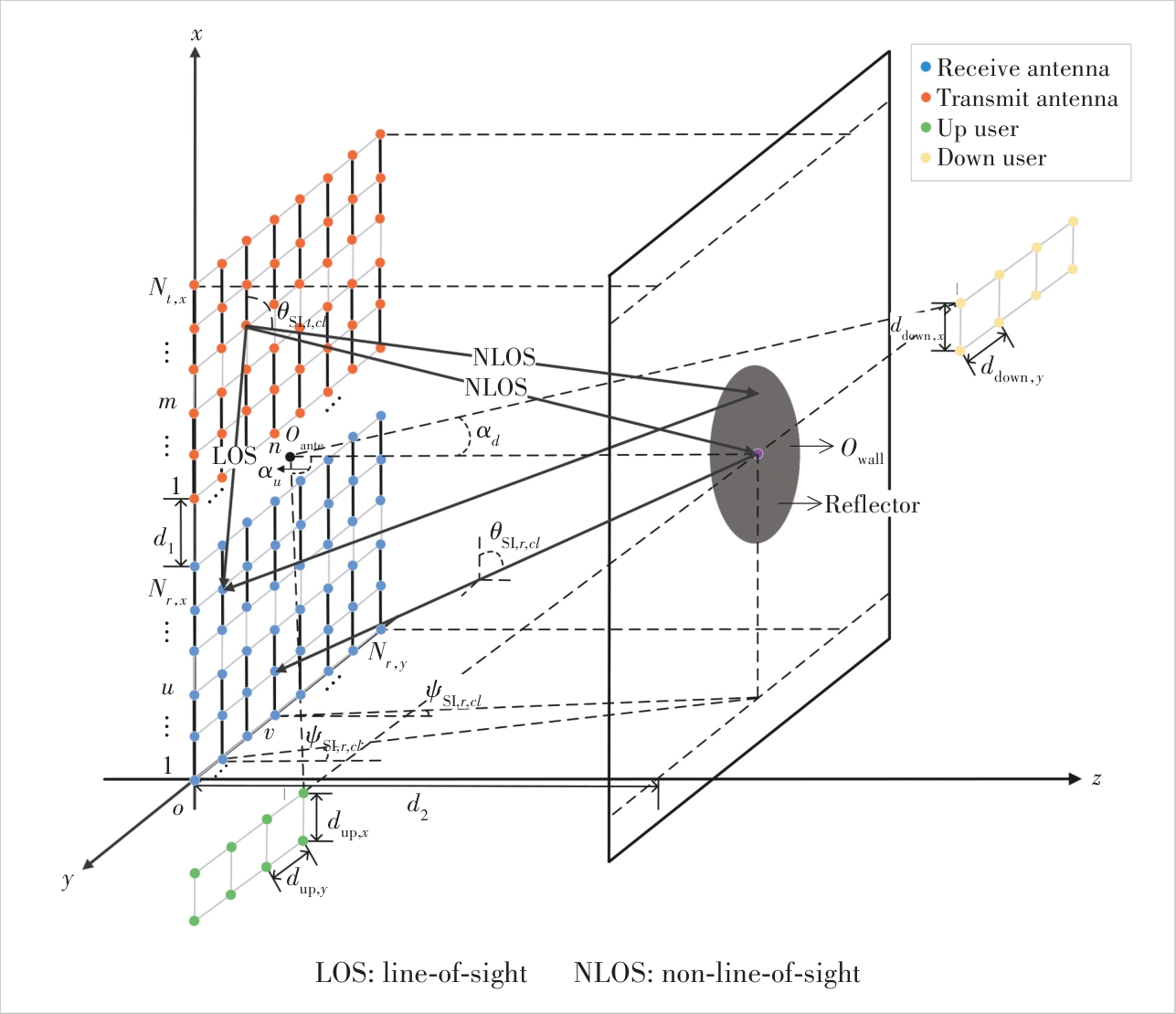
Figure 2 Application scenarios of FD massive MIMO system
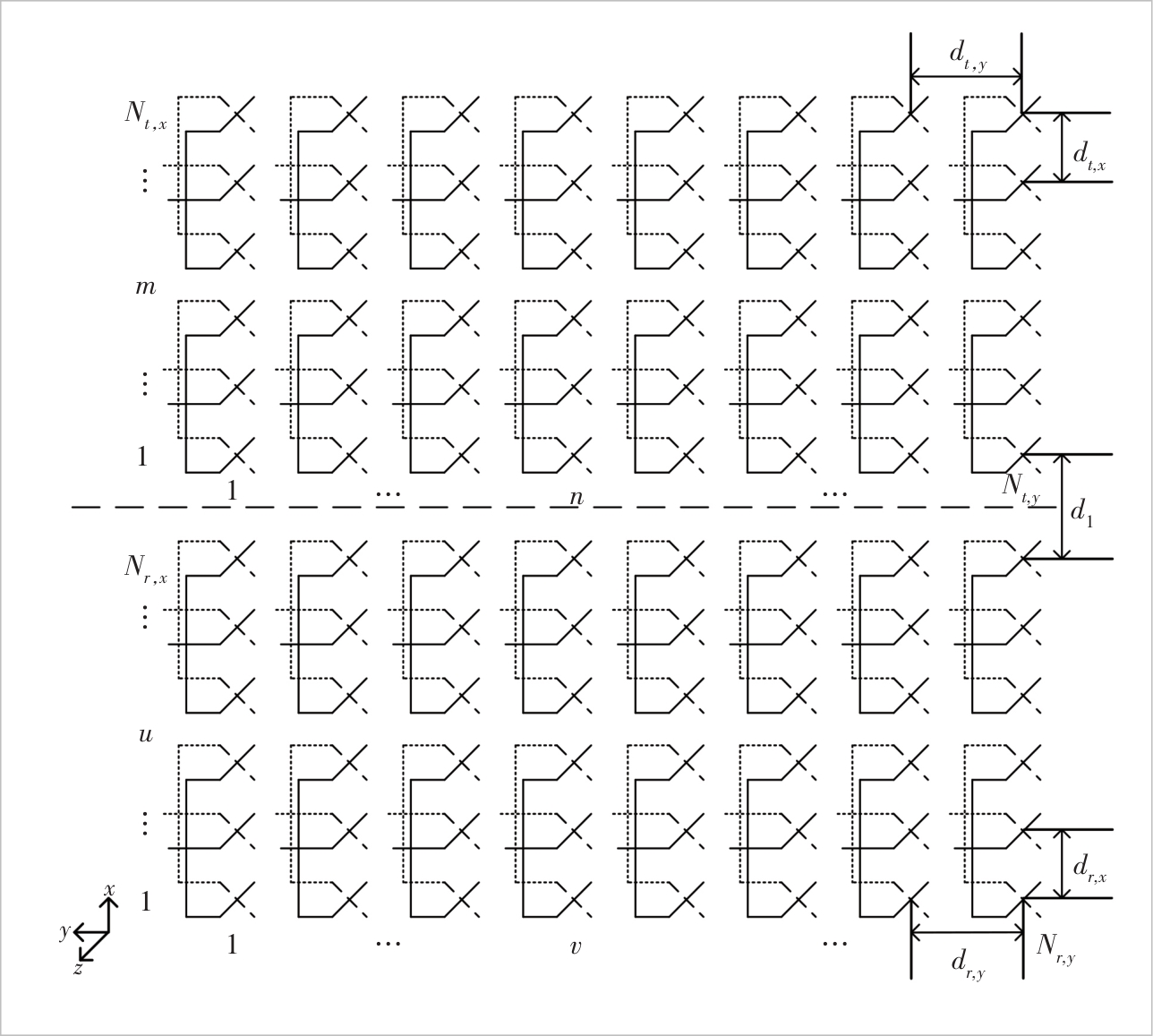
Figure 3 Base station transceiver’s uniform rectangular array structure
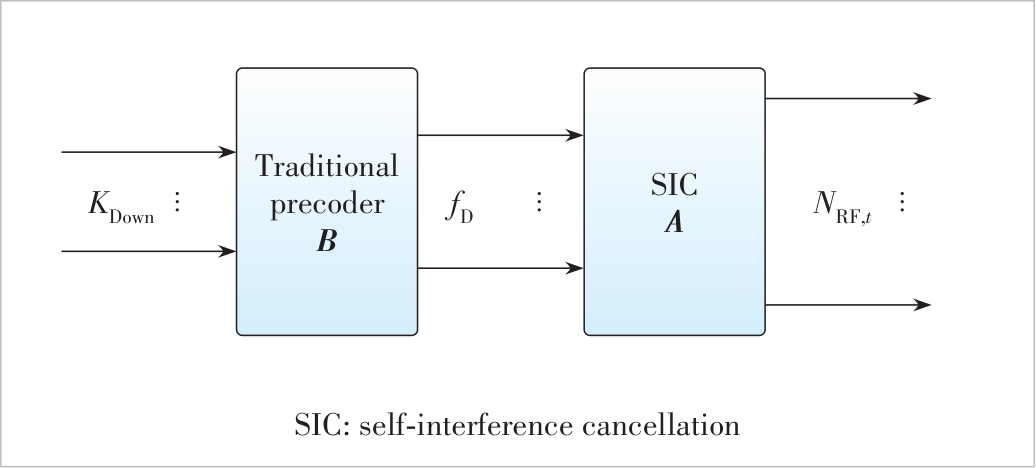
Figure 4 FD massive MIMO system with transmitting digital precoder
| Parameter | Value |
|---|---|
| Bandwidth | 100 MHz |
| Center frequency | 2.595 GHz |
| Transmit power of base station | 30 dBm |
| Transmit power of user | 30 dBm |
| Number of base station antennas | |
| Number of base station RF channels | |
| Number of uplink users | |
| Number of downlink users | |
| Antenna spacing along x-axis | |
| Antenna spacing along y-axis | |
| URAs spacing | |
| User spacing along x-axis | |
| User spacing along y-axis | |
| Cross-polarization isolation | |
| Path loss factor | |
| Number of uplink channel multipaths | |
| Number of downlink channel multipaths | |
| Number of SI channel multipaths |
Table 1 Simulation parameters of full-duplex massive MIMO system
| Parameter | Value |
|---|---|
| Bandwidth | 100 MHz |
| Center frequency | 2.595 GHz |
| Transmit power of base station | 30 dBm |
| Transmit power of user | 30 dBm |
| Number of base station antennas | |
| Number of base station RF channels | |
| Number of uplink users | |
| Number of downlink users | |
| Antenna spacing along x-axis | |
| Antenna spacing along y-axis | |
| URAs spacing | |
| User spacing along x-axis | |
| User spacing along y-axis | |
| Cross-polarization isolation | |
| Path loss factor | |
| Number of uplink channel multipaths | |
| Number of downlink channel multipaths | |
| Number of SI channel multipaths |

Figure 5 Impact of fD on SIC in received RF channels
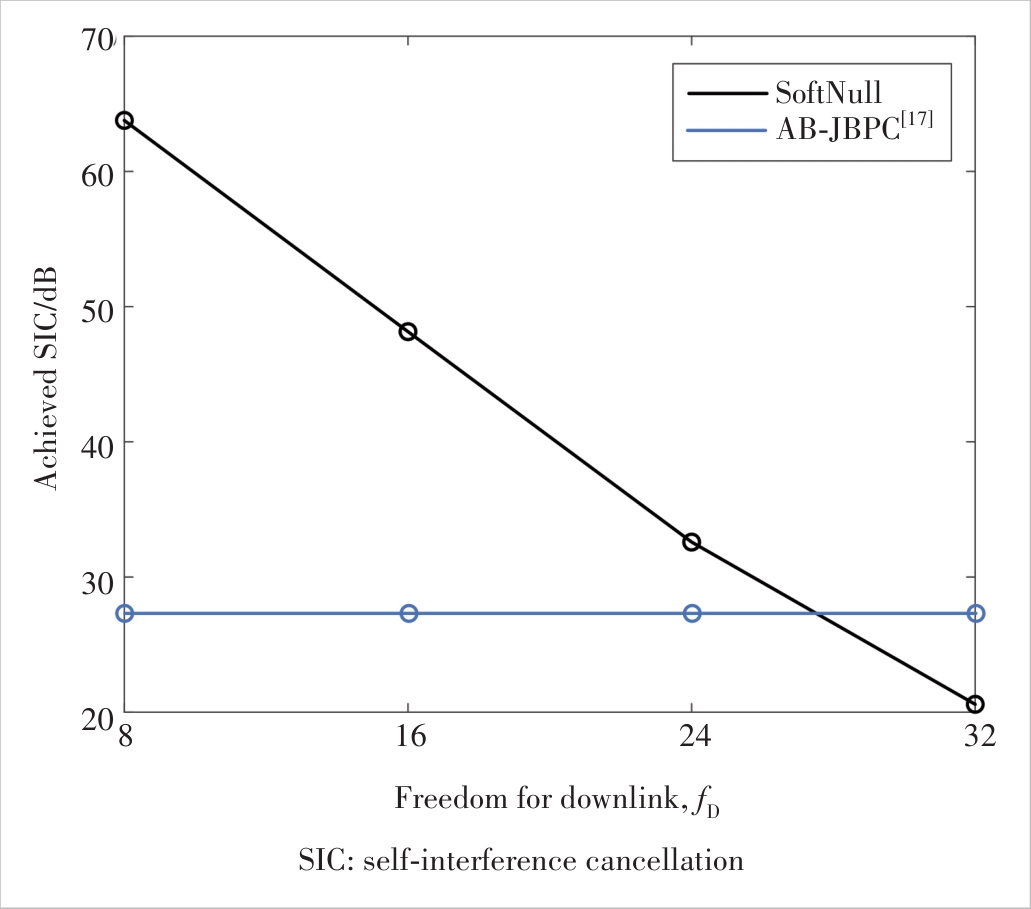
Figure 6 Impact of fD on total SIC
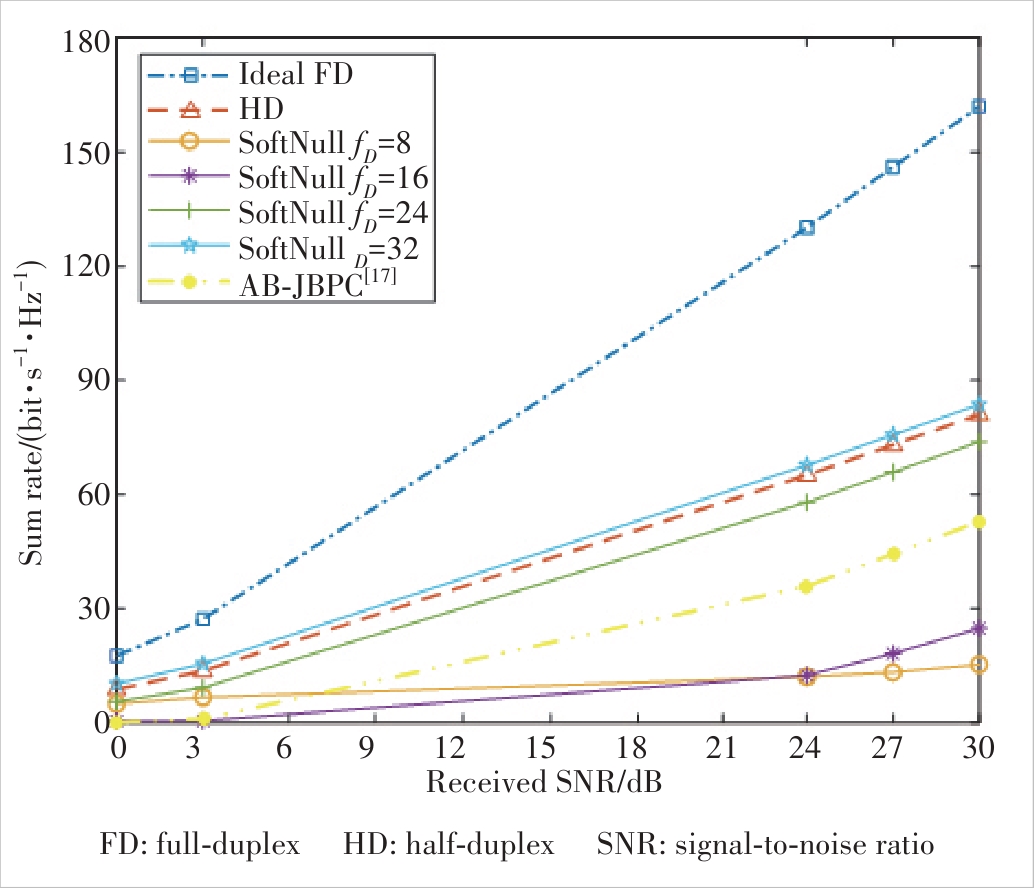
Figure 7 Impact of fD on sum rate

Figure 8 Impact of antenna isolation on sum rate

Figure 9 Impact of antenna isolation on sum rate with transceiveruniform rectangular array spacing of 5λ
| [1] | BOCCARDI F, HEATH R W, LOZANO A, et al. Five disruptive technology directions for 5G [J]. IEEE communications magazine, 2014, 52(2): 74–80. DOI: 10.1109/MCOM.2014.6736746 |
| [2] | AGIWAL M, ROY A, SAXENA N. Next generation 5G wireless networks: a comprehensive survey [J]. IEEE communications surveys & tutorials, 2016, 18(3): 1617–1655. DOI: 10.1109/COMST.2016.2532458 |
| [3] | HU Y F, WANG D M, LIANG C L, et al. Massive random access in cell-free massive MIMO system [J]. ZTE technology journal, 2024, 30(1): 26–32. DOI: 10.12142/ZTETJ.202401006 |
| [4] | HAN Y, ZHANG J Y, JIN S. U6G extra-large scale MIMO technology [J]. ZTE technology journal, 2024, 30(3): 67–71. DOI: 10.12142/ZTETJ.202403011 |
| [5] | ZHANG Z S, CHAI X M, LONG K P, et al. Full-duplex techniques for 5G networks: SI cancellation, protocol design, and relay selection [J]. IEEE communications magazine, 2015, 53(5): 128–137. DOI: 10.1109/MCOM.2015.7105651 |
| [6] | AGHABABAEETAFRESHI M, KORPI D, KOSKELA M, et al. Software defined radio implementation of a digital SI cancellation method for inband full-duplex radio using mobile processors [J]. Journal of signal processing systems, 2018, 90(10): 1297–1309. DOI: 10.1007/s11265-017-1312-0 |
| [7] | NGO H Q, LARSSON E G, MARZETTA T L. Energy and spectral efficiency of very large multiuser MIMO systems [J]. IEEE transactions on communications, 2013, 61(4): 1436–1449. DOI: 10.1109/TCOMM.2013.020413.110848 |
| [8] | HUANG Y M, HE S W, WANG J H, et al. Spectral and energy efficiency tradeoff for massive MIMO [J]. IEEE transactions on vehicular technology, 2018, 67(8): 6991–7002. DOI: 10.1109/TVT.2018.2824311 |
| [9] | TRAN T X, TEH K C. Spectral and energy efficiency analysis for SLNR precoding in massive MIMO systems with imperfect CSI [J]. IEEE transactions on wireless communications, 2018, 17(6): 4017–4027. DOI: 10.1109/TWC.2018.2819184 |
| [10] | PIRZADEH H, SWINDLEHURST A L. Spectral efficiency of mixed-ADC massive MIMO [J]. IEEE transactions on signal processing, 2018, 66(13): 3599–3613. DOI: 10.1109/TSP.2018.2833807 |
| [11] | ZHANG X, ZHONG L, SABHARWAL A. Directional training for FDD massive MIMO [J]. IEEE transactions on wireless communications, 2018, 17(8): 5183–5197. DOI: 10.1109/TWC.2018.2838600 |
| [12] | YIN B, WU M, STUDER C, et al. Full-duplex in large-scale wireless systems [C]//Asilomar Conference on Signals, Systems and Computers. IEEE, 2013: 1623–1627. DOI: 10.1109/ACSSC.2013.6810573 |
| [13] | NGO H Q, SURAWEERA H A, MATTHAIOU M, et al. Multipair full-duplex relaying with massive arrays and linear processing [J]. IEEE journal on selected areas in communications, 2014, 32(9): 1721–1737. DOI: 10.1109/JSAC.2014.2330091 |
| [14] | GOLDSMITH A. Wireless Communications [M]. Cambridge, UK: Cambridge University Press, 2005 |
| [15] | AHMED E, ELTAWIL A M. All-digital SI cancellation technique for full-duplex systems [J]. IEEE transactions on wireless communications, 2015, 14(7): 3519–3532. DOI: 10.1109/TWC.2015.2407876 |
| [16] | LE A T, TRAN L C, HUANG X J, et al. Beam-based analog SI cancellation in full-duplex MIMO systems [J]. IEEE transactions on wireless communications, 2020, 19(4): 2460–2471. DOI: 10.1109/TWC.2020.2965441 |
| [17] | ALEXANDROPOULOS G C, DUARTE M. Joint design of multi-tap analog cancellation and digital beamforming for reduced complexity full duplex MIMO systems [C]//Proceedings of IEEE International Conference on Communications (ICC). IEEE, 2017: 1–7. DOI: 10.1109/ICC.2017.7997175 |
| [18] | IIMORI H, THADEU FREITAS DE ABREU G. Two-way full-duplex MIMO with hybrid TX-RX MSE minimization and interference cancellation [C]//IEEE 19th International Workshop on Signal Processing Advances in Wireless Communications (SPAWC). IEEE, 2018: 1–5. DOI: 10.1109/SPAWC.2018.8445776 |
| [19] | KOC A, LE-NGOC T. Full-duplex mmWave massive MIMO systems: a joint hybrid precoding/combining and SI cancellation design [J]. IEEE open journal of the communications society, 2021, 2: 754–774. DOI: 10.1109/OJCOMS.2021.3069672 |
| [20] | SATYANARAYANA K, EL-HAJJAR M, KUO P H, et al. Hybrid beamforming design for full-duplex millimeter wave communication [J]. IEEE transactions on vehicular technology, 2019, 68(2): 1394–1404. DOI: 10.1109/TVT.2018.2884049 |
| [21] | EVERETT E, SHEPARD C, ZHONG L, et al. SoftNull: many-antenna full-duplex wireless via digital beamforming [J]. IEEE transactions on wireless communications, 2016, 15(12): 8077–8092. DOI: 10.1109/TWC.2016.2612625 |
| [1] | CHEN Zhe, ZHOU Peigen, WANG Long, HOU Debin, HU Yun, CHEN Jixin, HONG Wei. FTTR-MmWave Architecture for Next-Generation Indoor High-Speed Communications [J]. ZTE Communications, 2025, 23(4): 16-26. |
| [2] | CHENG Jiaming, CHEN Wei, LI Lun, AI Bo. Efficient Spatio-Temporal Predictive Learning for Massive MIMO CSI Prediction [J]. ZTE Communications, 2025, 23(1): 3-10. |
| [3] | TANG Chenyue, LI Zeshen, CHEN Zihan, YANG Howard H.. Device Activity Detection and Channel Estimation Using Score-Based Generative Models in Massive MIMO [J]. ZTE Communications, 2025, 23(1): 53-62. |
| [4] | SHAN Yaru, WANG Fanggang, HAO Yaxing, HUA Jian, XIN Yu. Doppler Rate Estimation for OTFS via Large-Scale Antenna Array [J]. ZTE Communications, 2025, 23(1): 115-122. |
| [5] | CHEN Guangyi, ZHANG Ruoyu, REN Hong, LIN Xu, WU Wen. Joint Beamforming Design for Dual-Functional Radar-Communication Systems Under Beampattern Gain Constraints [J]. ZTE Communications, 2024, 22(3): 13-20. |
| [6] | ZHU Yuting, XU Zhiyu, ZHANG Hongtao. Cooperative Distributed Beamforming Design for Multi-RIS Aided Cell-Free Systems [J]. ZTE Communications, 2024, 22(2): 99-106. |
| [7] | XIE Xinyu, WU Yongpeng, YUAN Zhifeng, MA Yihua. Massive Unsourced Random Access Under Carrier Frequency Offset [J]. ZTE Communications, 2023, 21(3): 45-53. |
| [8] | JI Yuhe, HAN Jing, ZHAO Yongxin, ZHANG Shenglin, GONG Zican. Log Anomaly Detection Through GPT-2 for Large Scale Systems [J]. ZTE Communications, 2023, 21(3): 70-76. |
| [9] | ZHU Yuting, LI Zeng, ZHANG Hongtao. Robust Beamforming Under Channel Prediction Errors for Time-Varying MIMO System [J]. ZTE Communications, 2023, 21(3): 77-85. |
| [10] | TANG Yuanqi, ZHANG Huimin, ZHENG Zheng, LI Ping, ZHU Yu. Hybrid Architecture and Beamforming Optimization for Millimeter Wave Systems [J]. ZTE Communications, 2023, 21(3): 93-104. |
| [11] | JIA Haonan, HE Zhenqing, TAN Wanlong, RUI Hua, LIN Wei. Distributed Multi-Cell Multi-User MISO Downlink Beamforming via Deep Reinforcement Learning [J]. ZTE Communications, 2022, 20(4): 69-77. |
| [12] | HOU Xiaolin, LI Xiang, WANG Xin, CHEN Lan, SUYAMA Satoshi. Some Observations and Thoughts about Reconfigurable Intelligent Surface Application for 5G Evolution and 6G [J]. ZTE Communications, 2022, 20(1): 14-20. |
| [13] | GUAN Xinrong, WU Qingqing. IRS‑Enabled Spectrum Sharing: Interference Modeling, Channel Estimation and Robust Passive Beamforming [J]. ZTE Communications, 2022, 20(1): 28-35. |
| [14] | SHAO Zhichao, YAN Wenjing, YUAN Xiaojun. Markovian Cascaded Channel Estimation for RIS Aided Massive MIMO Using 1‑Bit ADCs and Oversampling [J]. ZTE Communications, 2022, 20(1): 48-56. |
| [15] | WANG Dong, WANG Fanggang, LI Xiran, YUAN Pu, JIANG Dajie. Orthogonal Time Frequency Space Modulation in Multiple-Antenna Systems [J]. ZTE Communications, 2021, 19(4): 71-78. |
| Viewed | ||||||
|
Full text |
|
|||||
|
Abstract |
|
|||||