ZTE Communications ›› 2026, Vol. 24 ›› Issue (2): 16-25.DOI: 10.12142/ZTECOM.202602003
• Special Topic • Previous Articles Next Articles
Zhang Xiaotian1, Xiao Han1( ), Wang Dan2, Huang Zhenglei2, Xu Changqiao1
Received:2025-02-03
Online:2026-06-16
Published:2026-06-16
About author:Zhang Xiaotian received his BS degree in the School of Computer Science from Beijing University of Posts and Telecommunications (BUPT), China in 2024. He is currently working toward a doctoral degree in the School of Computer Science, BUPT. His research interests include multi-agent communication and AI.Supported by:Zhang Xiaotian, Xiao Han, Wang Dan, Huang Zhenglei, Xu Changqiao. Toward AI-Agent-Native 6G Networks: A Survey on Protocols, Multimodal Coordination, and ISCC-Driven Dynamic Networking[J]. ZTE Communications, 2026, 24(2): 16-25.
Add to citation manager EndNote|Ris|BibTeX
URL: https://zte.magtechjournal.com/EN/10.12142/ZTECOM.202602003
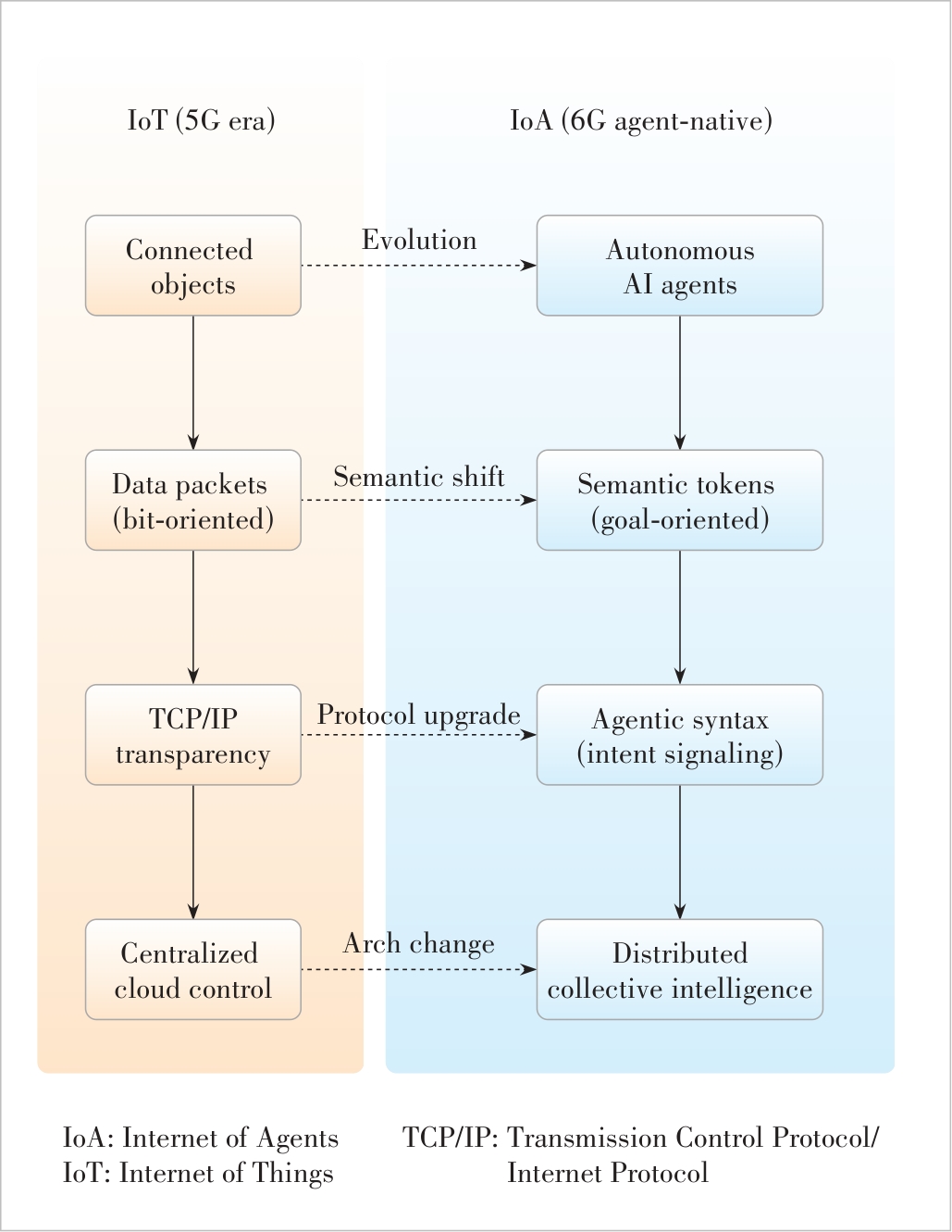
Figure 1 Evolution from IoT to IoA
Table 1 Comparison of architectural features: 6G agentic traffic vs traditional traffic
Table 2. 6 G agentic traffic characteristics vs traditional traffic

Table 3. Proposed KVIs for agent-centric networks
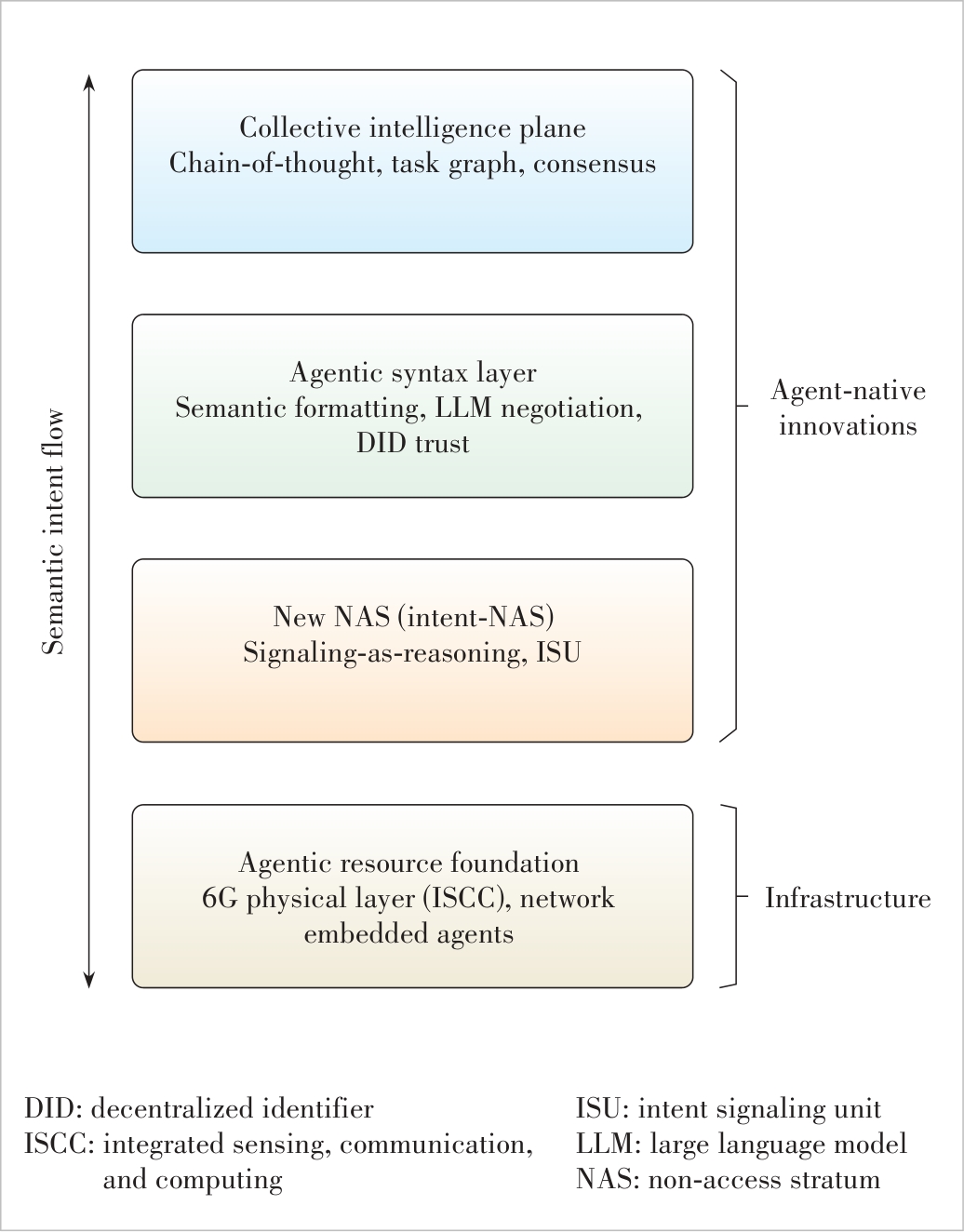
Figure 2 Agentic syntax protocol stack
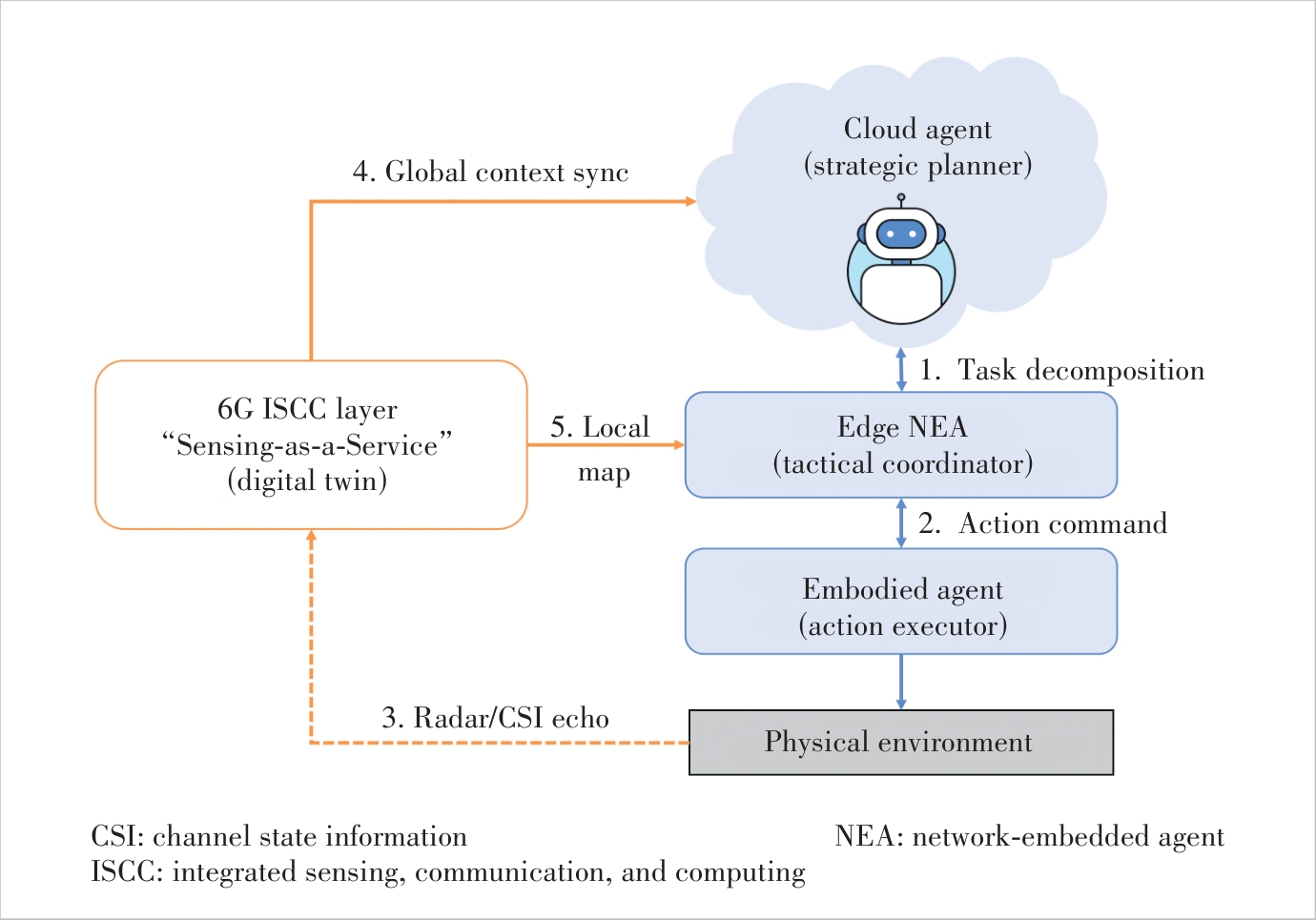
Figure 3 Multi-agent coordination loop
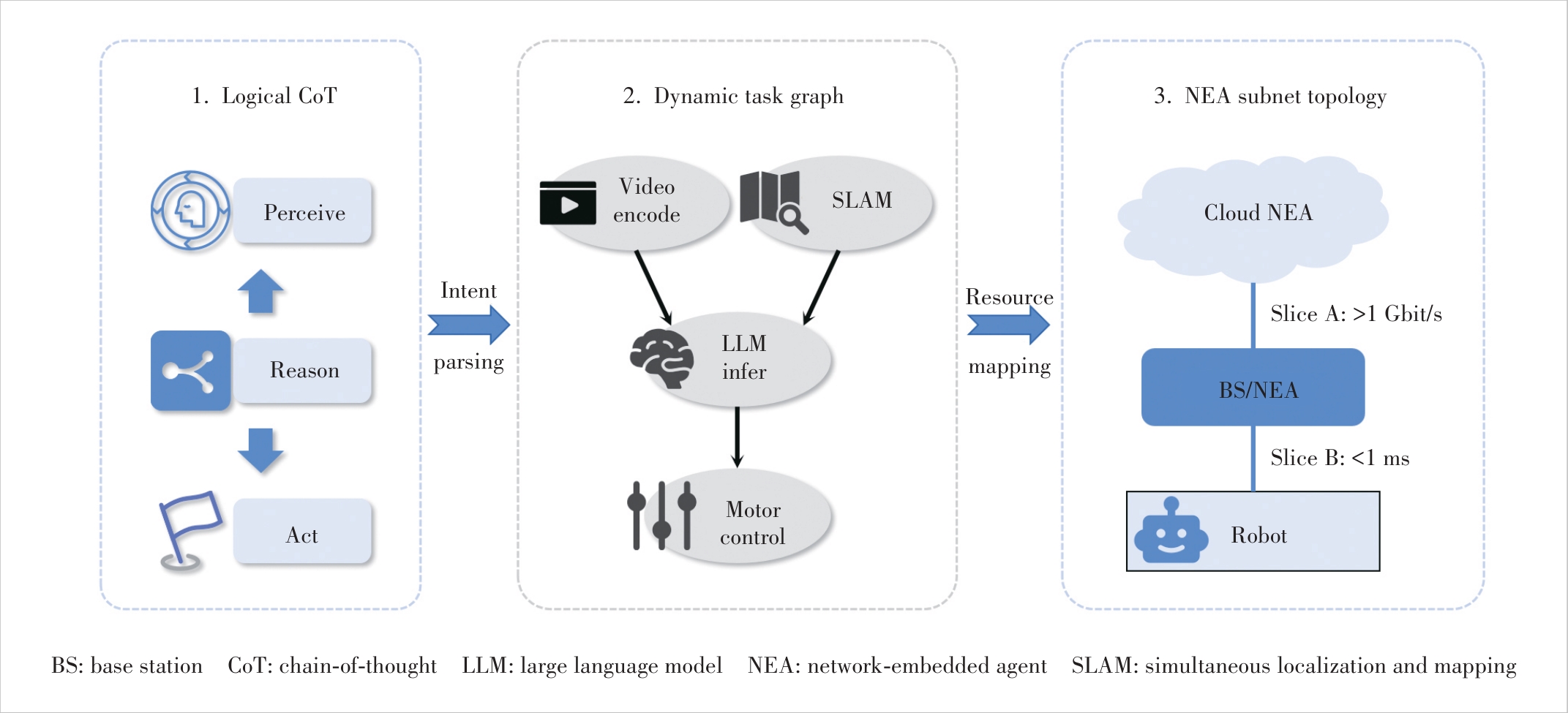
Figure 4 CoT to task graph to topology
| Feature Dimension | Traditional 5G/AI4Net | Proposed 6G/Agent4Net |
|---|---|---|
| Primary user | Humans and passive IoT sensors | Autonomous AI agents & embodied robots |
| Core function | Transparent data pipe (content-agnostic) | Intelligent substrate (intent-aware) |
| Protocol stack | TCP/IP + standard NAS | Agentic syntax and new NAS (intent-signaling) |
| Resource scheduling | Reactive (based on channel quality/CQI) | Predictive (based on task graph & ISCC) |
| Network topology | Static/semi-static slicing | Dynamic (task-triggered ephemeral subnets) |
| Routing mechanism | IP address (shortest path) | A-DNS (capability-based routing) |
| Role of AI | AI optimizes the network (overlay) | Network is built for AI (native design) |
Table 4 Architectural comparison: 5G AI4Net vs 6G Agent4Net
| Feature Dimension | Traditional 5G/AI4Net | Proposed 6G/Agent4Net |
|---|---|---|
| Primary user | Humans and passive IoT sensors | Autonomous AI agents & embodied robots |
| Core function | Transparent data pipe (content-agnostic) | Intelligent substrate (intent-aware) |
| Protocol stack | TCP/IP + standard NAS | Agentic syntax and new NAS (intent-signaling) |
| Resource scheduling | Reactive (based on channel quality/CQI) | Predictive (based on task graph & ISCC) |
| Network topology | Static/semi-static slicing | Dynamic (task-triggered ephemeral subnets) |
| Routing mechanism | IP address (shortest path) | A-DNS (capability-based routing) |
| Role of AI | AI optimizes the network (overlay) | Network is built for AI (native design) |
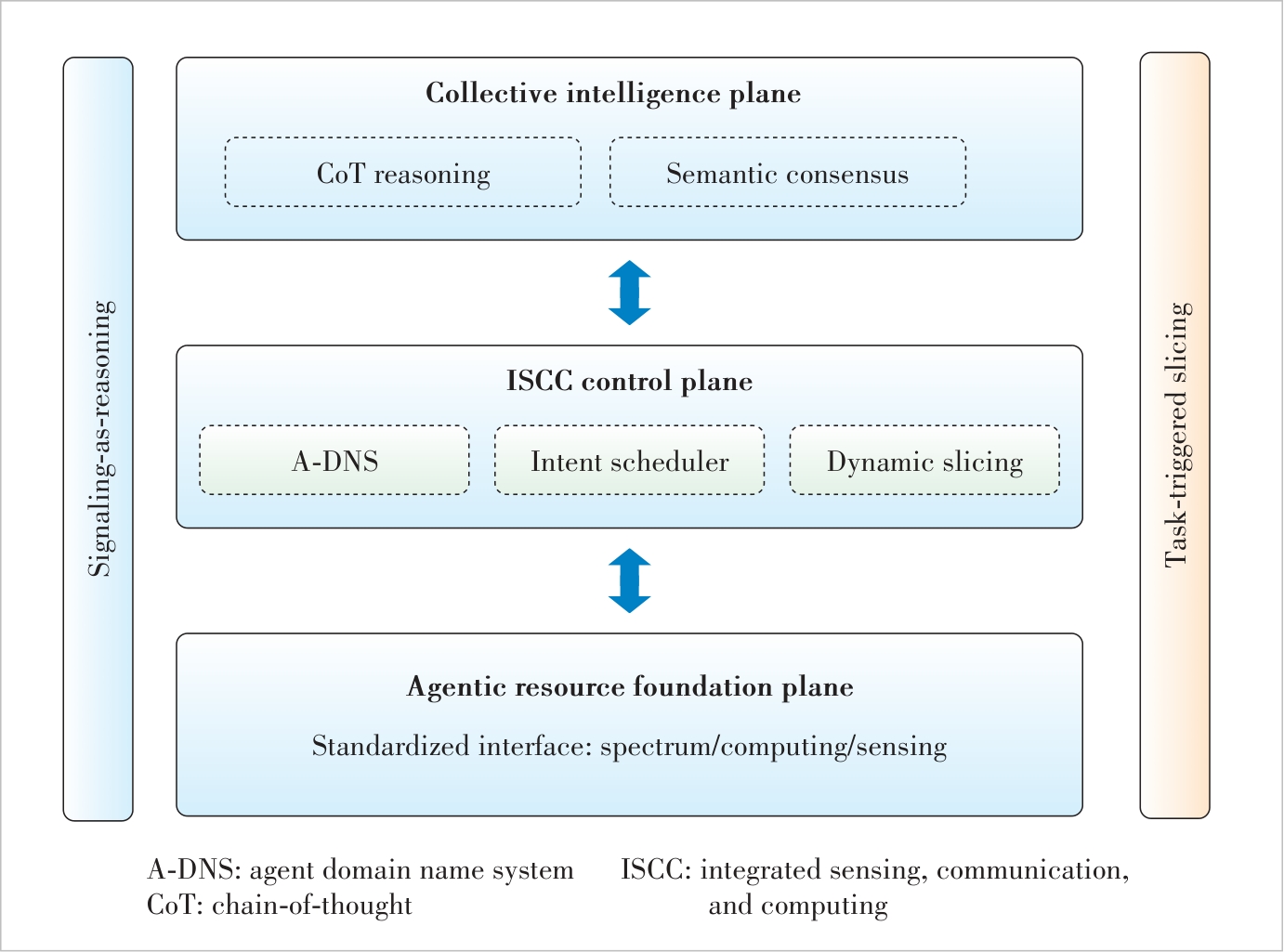
Figure 5 DAN-Arch framework
| [1] | Letaief K B, Chen W, Shi Y M, et al. The roadmap to 6G: AI empowered wireless networks [J]. IEEE communications magazine, 2019, 57(8): 84–90. DOI: 10.1109/mcom.2019.1900271 |
| [2] | Chen Z Q, Sun Q, Li N, et al. Enabling mobile AI agent in 6G era: architecture and key technologies [J]. IEEE network, 2024, 38(5): 66–75. DOI: 10.1109/mnet.2024.3422309 |
| [3] | Wang C X, You X H, Gao X Q, et al. On the road to 6G: visions, requirements, key technologies, and testbeds [J]. IEEE communications surveys & tutorials, 2023, 25(2): 905–974. DOI: 10.1109/comst.2023.3249835 |
| [4] | Zhang Z Q, Xiao Y, Ma Z, et al. 6G wireless networks: vision, requirements, architecture, and key technologies [J]. IEEE vehicular technology magazine, 2019, 14(3): 28–41. DOI: 10.1109/mvt.2019.2921208 |
| [5] | Wei J, Wang X, Schuurmans D, et al. Chain-of-thought prompting elicits reasoning in large language models [PP/OL]. arXiv (2023-01-10) [2026-01-12]. |
| [6] | Nguyen D C, Ding M, Pathirana P N, et al. 6G Internet of Things: a comprehensive survey [J]. IEEE Internet of Things journal, 2022, 9(1): 359–383. DOI: 10.1109/jiot.2021.3103320 |
| [7] | Chen M K, Liu M H, Wang C Y, et al. Cross-modal graph semantic communication assisted by generative AI in the metaverse for 6G [J]. Research, 2024, 7: 342. DOI: 10.34133/research.0342 |
| [8] | Wang Z R, Chen M K, Liu Q. A review on multimodal communications for human-robot collaboration in 5G: from visual to tactile [J]. Intelligence & robotics, 2025, 5(3): 579–606. DOI: 10.20517/ir.2025.30 |
| [9] | Wang R J, Chen K M, Li S J, et al. Efficient semantic codec for real-time vibrotactile transmission [C]//The 33rd ACM International Conference on Multimedia. ACM, 2025: 12092–12101. DOI: 10.1145/3746027.3755630 |
| [10] | Saad W, Bennis M, Chen M Z. A vision of 6G wireless systems: applications, trends, technologies, and open research problems [J]. IEEE network, 2020, 34(3): 134–142. DOI: 10.1109/mnet.001.1900287 |
| [11] | Qin Z, Tao X, Lu J, et al. Semantic communications: principles and challenges [PP/OL]. arXiv (2022-06-27) [2026-01-12]. |
| [12] | Chen J, Zhang H, Xie Z. Space-air-ground integrated network (SAGIN): a survey [PP/OL]. arXiv (2023-07-27) [2026-01-12]. |
| [13] | Shao J W, Mao Y Y, Zhang J. Task-oriented communication for multidevice cooperative edge inference [J]. IEEE transactions on wireless communications, 2023, 22(1): 73–87. DOI: 10.1109/twc.2022.3191118 |
| [14] | Zhang P, Xu W J, Gao H, et al. Toward wisdom-evolutionary and primitive-concise 6G: a new paradigm of semantic communication networks [J]. Engineering, 2022, 8: 60–73. DOI: 10.1016/j.eng.2021.11.003 |
| [15] | Strinati E C, Barbarossa S. 6G Networks: beyond Shannon towards semantic and goal-oriented communications [PP/OL]. arXiv (2021-02-17) [2026-01-12]. |
| [16] | Liang C, Du H, Sun Y, et al. Generative AI-driven semantic communication networks: architecture, technologies and applications [PP/OL]. arXiv(2024-01-07) [2026-01-12]. |
| [17] | Dong R, She C Y, Hardjawana W, et al. Deep learning for hybrid 5G services in mobile edge computing systems: learn from a digital twin [J]. IEEE transactions on wireless communications, 2019, 18(10): 4692–4707. DOI: 10.1109/twc.2019.2927312 |
| [18] | Liu F, Zhou L F, Masouros C, et al. Toward dual-functional radar-communication systems: optimal waveform design [J]. IEEE transactions on signal processing, 2018, 66(16): 4264–4279. DOI: 10.1109/tsp.2018.2847648 |
| [19] | Yang Z, Chen M, Wong K-K, et al. Federated learning for 6G: applications, challenges, and opportunities [PP/OL]. arXiv (2021-01-05) [2026-01-12]. |
| [20] | Xie H Q, Qin Z J, Li G Y, et al. Deep learning enabled semantic communication systems [J]. IEEE transactions on signal processing, 2021, 69: 2663–2675. DOI: 10.1109/tsp.2021.3071210 |
| [21] | Vetriveeran D, Leena Sri R. Resource provisioning in fog computing—a survey [J]. ACM computing surveys, 2025, 57(12): 1–26. DOI: 10.1145/3744662 |
| [22] | Chen M, Hao Y X, Hwang K, et al. Disease prediction by machine learning over big data from healthcare communities [J]. IEEE access, 2017, 5: 8869–8879. DOI: 10.1109/access.2017.2694446 |
| [23] | Pang L, Yang C G, Chen D Y, et al. A survey on intent-driven networks [J]. IEEE access, 2020, 8: 22862–22873. DOI: 10.1109/access.2020.2969208 |
| [24] | Uysal E, Kaya O, Baghaee S, et al. Age of information in practice [PP/OL]. arXiv (2021-06-02) [2026-01-12]. |
| [25] | Akyildiz I F, Han C, Nie S. Combating the distance problem in the millimeter wave and terahertz frequency bands [J]. IEEE communications magazine, 2018, 56(6): 102–108. DOI: 10.1109/mcom.2018.1700928 |
| [26] | Mao Y Y, You C S, Zhang J, et al. A survey on mobile edge computing: the communication perspective [J]. IEEE communications surveys & tutorials, 2017, 19(4): 2322–2358. DOI: 10.1109/comst.2017.2745201 |
| No related articles found! |
| Viewed | ||||||
|
Full text |
|
|||||
|
Abstract |
|
|||||