ZTE Communications ›› 2026, Vol. 24 ›› Issue (2): 33-42.DOI: 10.12142/ZTECOM.202602005

• Special Topic • Previous Articles     Next Articles

Internet of Agents: Design of the Protocol System

Fu Yuexia, Liu Peng, Lu Lu(), Duan Xiaodong   

  1. China Mobile Research Institute, Beijing 100053, China
  • Received:2026-03-11 Online:2026-06-16 Published:2026-06-16
  • About author:Fu Yuexia is a researcher at the China Mobile Research Institute and serves as the Vice Chairman of FG AINN in ITU-T SG13. Her main research interests include computing force networks and new technologies of future networks.
    Liu Peng is a senior engineer of the China Mobile Research Institute. His main research interests include next-generation IP technologies, computing-aware traffic steering routing, and new technologies and applications of integrated computing and networking.
    Lu Lu (lulu@chinamobile.com) is the Deputy Director of the Department of Basic Network Technology at the China Mobile Research Institute, a leader of the core network group of CCSA TC5, and a Vice Chairman of ITU-T SG13. Her research interests include 5G-A/6G network architecture and computing force networks.
    Duan Xiaodong is the Vice President of the China Mobile Research Institute and a leader of the network technology group of IMT-2030 (6G). His research interests include 5G/6G architecture, computing force networks, and new IP technologies.
  • Supported by:
    the National Key R&D Program of China(2024YFB2906701)

Abstract:

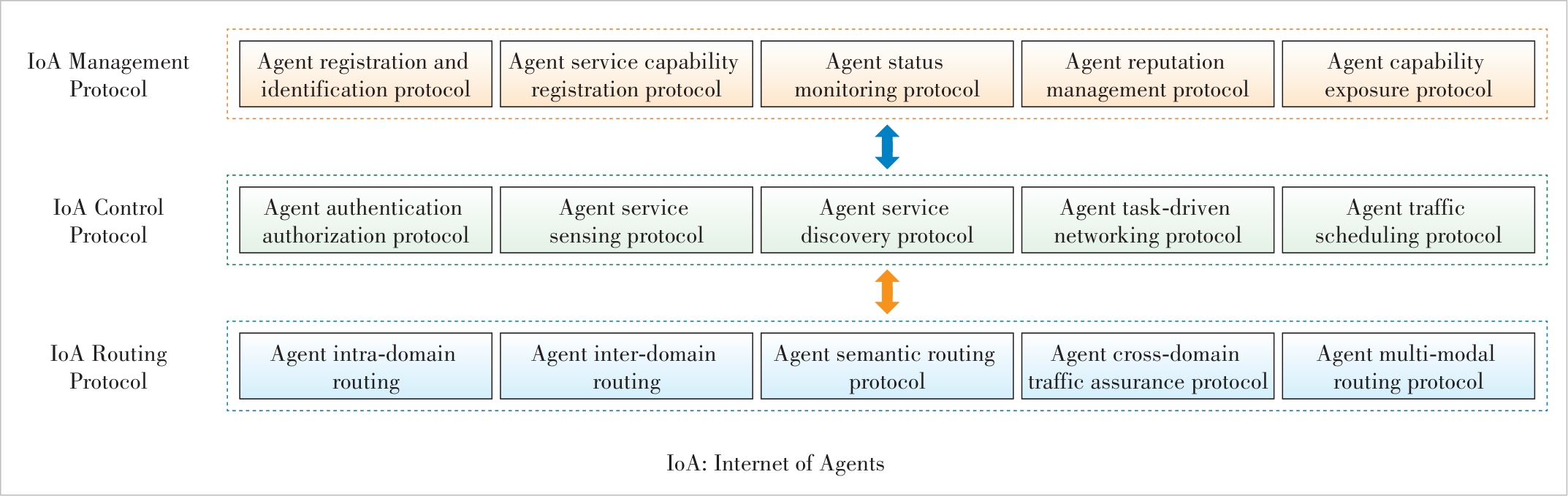
With the rapid advancement of generative artificial intelligence (AI) and large language model (LLM) technologies, AI agents are gradually becoming the core service units in networks, and their communication mode is evolving from local collaboration to wide-area interconnection. The construction of the Internet of Agents (IoA) faces multiple challenges, such as identity management, dynamic networking, and semantic routing, which urgently requires the design of a network protocol system that adapts to its new traffic characteristics and collaboration needs. Based on the application scenarios of agent communication, this paper systematically analyzes the management, control, and routing requirements that multi-agent collaboration imposes on IP networks, proposes a three-layer functional architecture for the IoA, and designs a protocol suite covering management, control, and routing around key issues such as agent registration and identification, service discovery, capability sensing, and cross-domain traffic assurance. By extending existing Internet protocols and introducing a semantically aware routing mechanism, this paper provides a scalable, efficient, and secure approach to implementing a protocol for end-to-end agent collaboration, thereby contributing to the construction of an open, large-scale agent collaboration ecosystem.

Key words: Internet of Agents, user agent, service agent, protocol framework